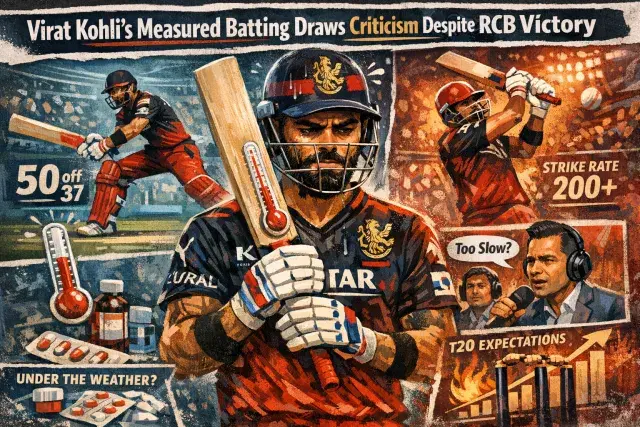
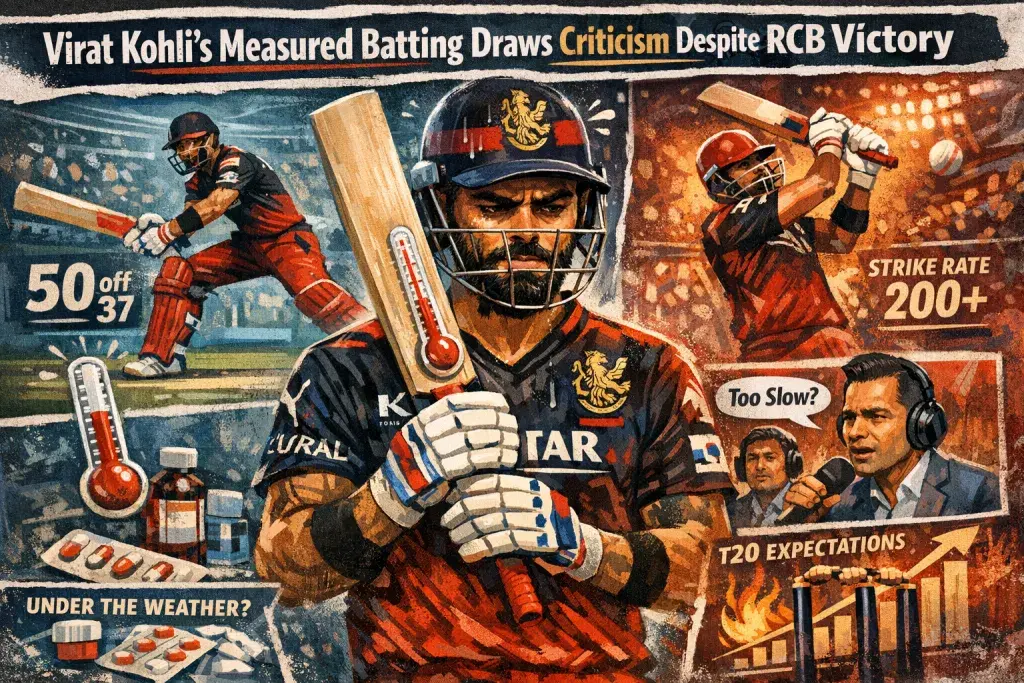
Virat Kohli's half-century against Mumbai Indians has sparked a pointed debate about what responsible batting looks like in the modern Twenty20 format. While Royal Challengers Bengaluru secured a comfortable result, Kohli's fifty off 37 deliveries stood in sharp contrast to every other batter in his side, all of whom maintained a strike rate above 200. The quiet question now circling commentary boxes and cricket discussions is whether the context of poor health excuses a performance that, on the surface, sits uneasily with what the format demands.
A Knock That Stood Apart From Its Surroundings
Numbers rarely lie, and in this instance they tell a clear story. While his colleagues were striking the ball with rare aggression, Kohli anchored the innings at a pace that, removed from its context, would have looked conservative even in a fifty-over format. He eventually fell to Hardik Pandya on the very delivery after completing his fifty, leaving behind a knock that divided opinion rather than settling it.
Veteran commentator and former opener Aakash Chopra addressed the performance directly, describing it as "very slow" and out of step with both the demands of the contest and Kohli's own standards. "This kind of knock is unbecoming of the contest, and neither is it becoming of Virat," Chopra said — a measured but pointed observation from someone who has spent considerable time analysing the format's evolving requirements.
Health as Context, Not Excuse
What Chopra's critique did not fully account for, or at least did not foreground, is the physical condition Kohli was managing during that innings. Reports indicate he was dealing with a high fever and persistent headache before taking the field — a significant physical burden for any individual required to perform under intensity and pressure. He did not field in the same fixture, which itself signals that his participation was already compromised before a single delivery was faced.
This changes the analytical frame considerably. Scoring a fifty under physical duress, and doing so with enough composure to hold one end together while colleagues played freely, is not the same as a batsman who is fit and simply choosing to bat slowly. The distinction matters. Kohli was not squandering the powerplay or hoarding strike in a tight finish — he was managing his body while still contributing meaningfully to a winning result.
Kohli's Broader Trajectory in This Season
Viewed against the wider arc of this IPL season rather than a single innings, Kohli's record offers a different picture. His strike rate in IPL 2026 has held at 162 — a figure that, according to available context, is higher than any previous season he has played in the competition. That is not a trivial data point. It suggests a genuine evolution in his approach to the format, one that a single below-par performance against the backdrop of illness should not entirely overshadow.
The T20 format has changed profoundly over the past several years. Scoring philosophies that were once considered aggressive are now baseline expectations. The benchmark for what constitutes a respectable strike rate has been revised sharply upward by a generation of batters who attack from the first delivery. Kohli, a batsman whose instincts were shaped in a different era, has had to consciously adapt — and by the evidence of this season, has largely done so. One subdued innings, delivered while running a fever, is an incomplete basis for a broader verdict.
Performance, Expectation, and the Weight of Reputation
There is a particular burden that comes with being one of the most closely watched cricketers of a generation. Every innings Kohli plays is filtered through an accumulated weight of expectation that few others carry. Chopra's criticism, fair as it may be from a purely technical standpoint, reflects that burden as much as it reflects the innings itself. The same knock, produced by a lesser-known batter managing illness, would likely have passed without comment.
The more instructive question is not whether this particular fifty was slow, but whether Kohli's overall adaptation to the demands of the format is holding. On present evidence, the answer leans positive. A single performance, shaped by circumstances that were neither ideal nor fully within his control, should be read accordingly — as an outlier, not a pattern.